

I didn’t intend to compare these two current-year sport bikes. But after riding a 2026 BMW S 1000 RR and a 2026 Yamaha YZR-R1M in essentially stock form and then reviewing the data and my subjective feedback, I felt compelled to publish my thoughts.
How could two motorcycles with similar chassis design and engine architecture produce such close lap times yet feel completely different? Which one did I like more? Would my personal S 1000 RR (and current open-class favorite) be put out to pasture? Let’s get into it.
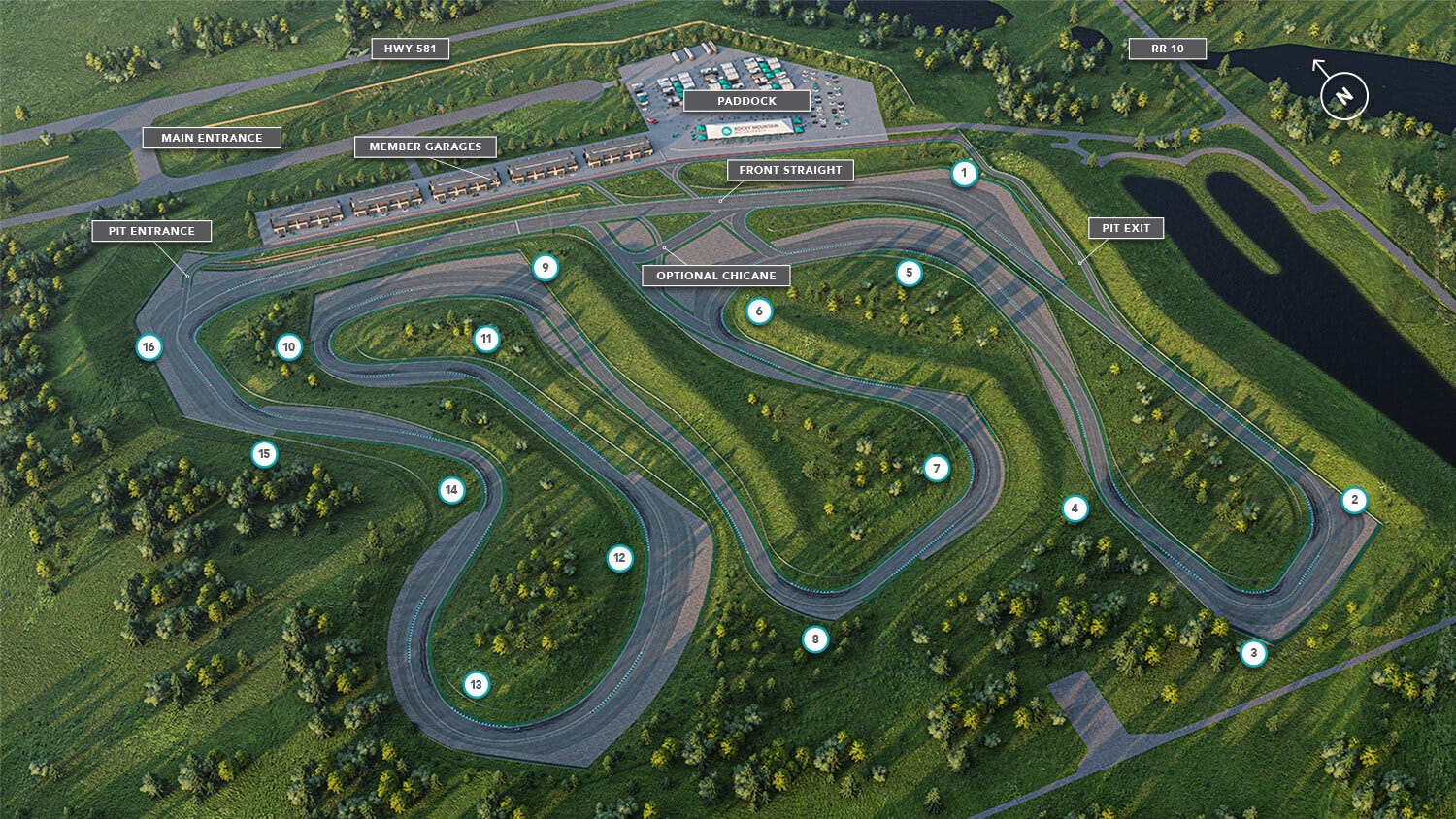
This summer, I held two schools at Rocky Mountain Motorsports in Calgary, Alberta. RMM is a diabolical track: tight, technical, and pool-table smooth, with high grip, blind corners, and late apexes. It’s the perfect place to put these two bikes through their paces.
Before we go too far, I want to clarify a few points. This wasn’t a controlled editorial-style shootout. That would have required me to ride both bikes on the same day, on the same tires, and with the same hot-lap opportunities.
I rode these bikes a couple of months apart, but on the same track and in nearly identical conditions. Both were also ridden during school sessions, so clear laps were few and far between. In fact, I never had a single completely clear lap on the YZF-R1M.
Motorcycles
Both bikes were demo models and mechanically 100% stock, the only addendum being the tires on the YZF-R1M. The R1M has almost no engine restrictions, while the BMW is nearly unrideable in its stock North America restricted tune, especially at the pace I was riding.
On the other hand, the Yamaha’s tires didn’t offer the grip of the rubber mounted on the BMW. A perfect, no caveats comparison? No, but the differences evened out and, if nothing else, the setups were close enough to make the results interesting.
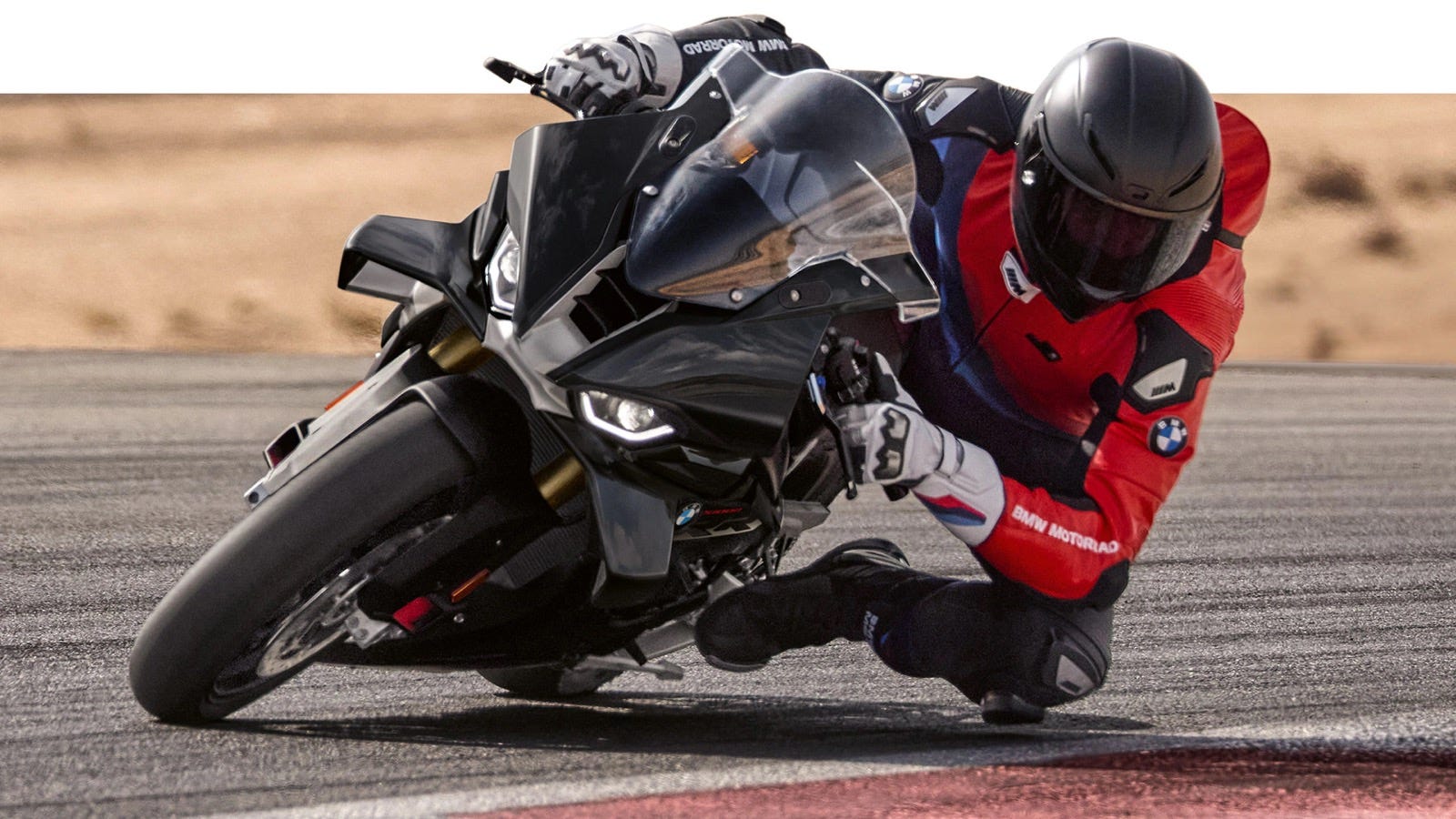
2026 BMW S 1000 RR with M Package
Pirelli Diablo Supercorsa TD/SC3
OEM-restricted ECU
Optimized engine electronics settings
As-delivered suspension settings
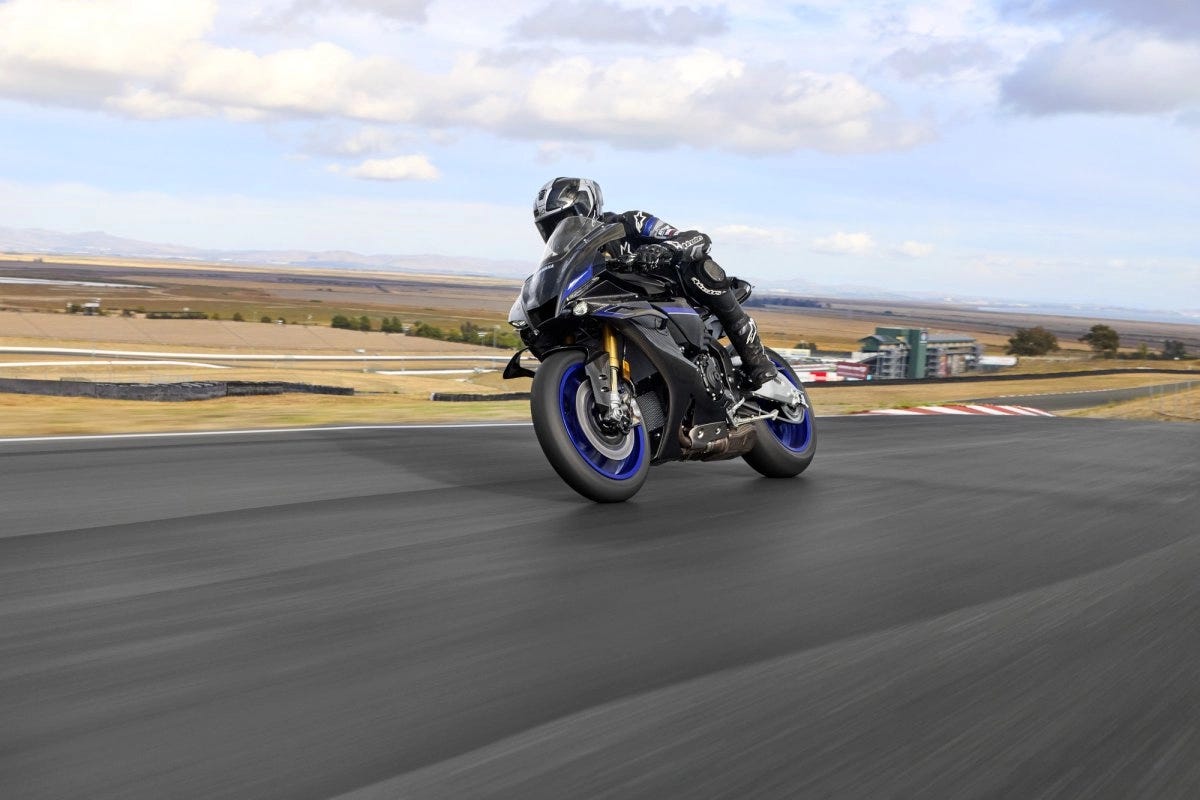
2026 Yamaha YZF-R1M
Bridgestone Battlax Hypersport S23
Optimized engine and suspension electronics settings
In my hands around RMM’s standard-orientation, 16-turn, 3.5-kilometer circuit, the S 1000 RR and the YZF-M1 couldn’t have felt more different. Yet their lap times were incredibly close. That gap between feel and result is where the real comparison begins.
Ergonomics
The BMW has a much shorter seat-to-bar distance. It also has higher clip-ons. Both bikes have high footpegs, and the BMW’s pegs were surprisingly slippery. On the Yamaha, I found it difficult to get enough weight off my hands.
Neither motorcycle was designed for sport-touring, but the BMW fit me better. More importantly, at least for riding at pace, the angle and height of the bars made it easier for me to support myself properly and stay free on the controls.
Winner: BMW. It just felt right.
Engine
This is a tale of two completely different powerbands. The R1M is incredibly linear and smooth, almost lazy-feeling. The S 1000 RR is the opposite, pulling hard with great low-end torque and coming alive with a ripping ShiftCam top end. It feels fast.
The R1M’s crossplane engine can fool you into thinking it’s slow. It isn’t. The drive-throttle connection between your right hand and the rear tire is immediate and intoxicating. You have a clear sense of what you’re asking the rear tire to do, at any throttle opening.
Whereas the BMW has fantastic initial throttle response, the Yamaha is more abrupt. The S 1000 RR feels explosive, yet it lacks a direct throttle-to-rear-tire connection. The R1M, meanwhile, delivers an incredible connection to the tire.
Winner: Yamaha, for its confidence-inspiring power delivery and rear-tire connection.
Engine electronics
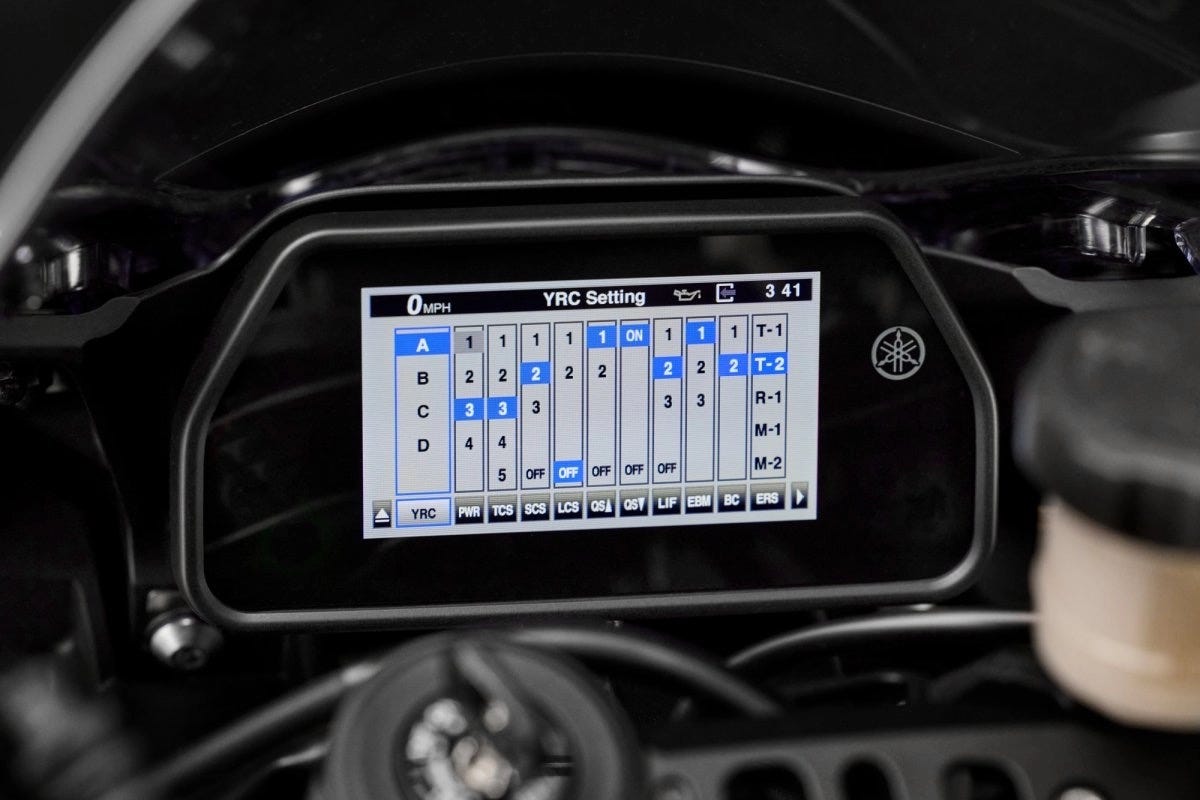
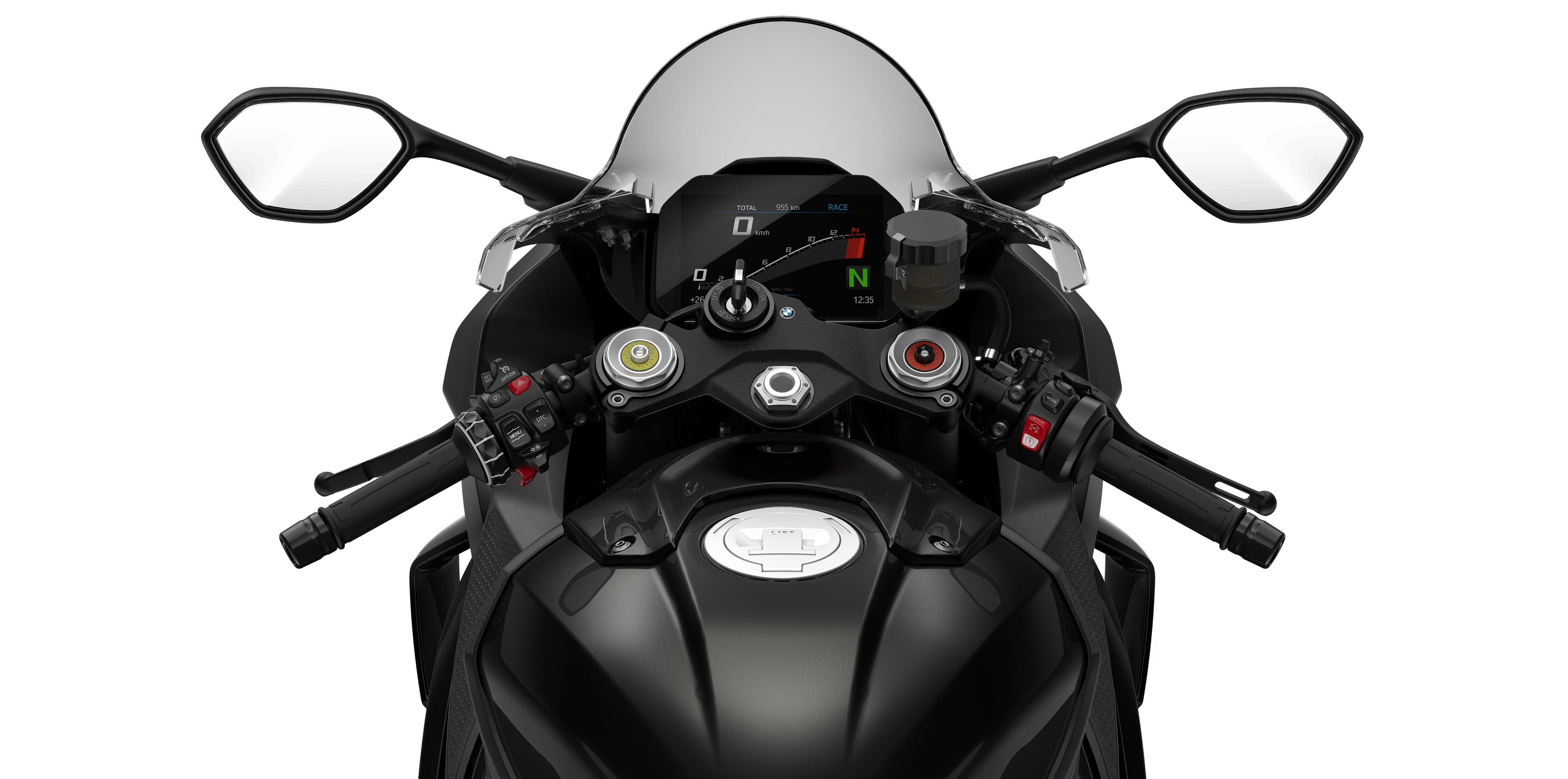
The Yamaha’s dash is complicated to navigate. The BMW’s dash is much simpler and easier to read at speed. Even using known settings with lower-grip tires, I rarely felt the R1M electronics working, with the exception of wheelie control.
The BMW electronics gave me more feedback, but the bike was still moving forward. Curiously, wheelie control comes in later, but when it does arrive, it is more intrusive. The Yamaha’s intervention is softer and less disruptive. Engine braking felt similar.
I wish I had access to the full data available from the BMW and Yamaha ECUs to better understand in greater detail the differences between the two bikes.
Winner: BMW, but this one was close. The S 1000 RR wins for its ease of use and clear feedback.
Brakes
Both motorcycles had a firm lever with zero fade. The R1M’s brakes felt more powerful, but they provided less feel. Some of that may have been related to the tires. I never experienced ABS intervention on the R1M, and I only felt it once on the S 1000 RR, even in its lowest setting.
The stock BMW rotors felt warped on brake initiation. I noticed the same thing on my personal S 1000 RR. Both bikes were held back in optimum braking performance by stock fork internals. More on that in the suspension section.
The BMW stood out with excellent feel while releasing the lever under load and lean angle. Maximum braking force gets a lot of attention, but being able to accurately manipulate final pressure approaching the slow point of the corner is just as important, if not more important.
Winner: BMW, for its superior brake feel at deep lean angles. Note: Brake feel is directly related to the fork internals and settings.
Suspension
This wasn’t even close. The R1M uses Öhlins 2.0 electronic suspension, and I’m not a fan. It felt overdamped and slow to react. The adjustment range is broad, but I still couldn’t get the feeling close to where I wanted it for quick, consistent, fast-paced track riding.
The R1M fork remained very stiff even after I made several counter adjustments. At the opposite end, the shock was too soft. Even after maximizing compression damping, the shock was still too soft and slow for what I needed at RMM.
The BMW? I made zero suspension adjustments, and it felt almost like a race bike. Firm where needed, compliant where required, and remarkably composed, especially considering I didn’t touch a single setting front or rear.
Both front ends exhibited hydraulic lock near the bottom of the stroke. That made it difficult to continue building brake force when I wanted to brake where my brain was telling me to do so. That became especially important when I was going for a quick lap time.
Winner: BMW. Hands down. That said, read my notes at the end about the standard YZF-R1.
Chassis
BMW nailed the chassis geometry with the stock-sized tires. The S 1000 RR reacts like a properly set-up race bike. Turn-in, brake release, trajectory on exits: The bike does everything well. It also transitions from side to side significantly quicker than the R1M, whose stiff fork and soft shock compromise its geometry on track.
There was very little I wanted from the BMW chassis that it didn’t already do. Again, read the notes at the end of this comparison for my thoughts on the standard YZF-R1 versus the YZF-M1 that I rode at RMM.
Winner: BMW. It feels almost like a race bike right off the showroom floor.
Transmission and gearing
Both bikes have tall OEM gearing, but how the two engines deal with that gearing is completely different. The characteristics of the R1M’s tune and crossplane engine allowed it to handle the tall gearing surprisingly well. I never had to use first gear.
The BMW was a different story. Due to the restricted tune, I had to use first gear for almost a quarter of the lap. At speed, this took most of my brain space. The BMW’s quickshifter and autoblip system, however, worked seamlessly, better than the system on the R1M.
The BMW’s traction control also intervened hard during wide-open, first-to-second-gear upshifts, even with TC at -4 in Pro Riding Mode. The BMW also has a more forgiving slipper clutch, which became noticeable with my many downshifts into first gear.
Winner: BMW, due to its more sophisticated and modern overall feel.
Stability
The R1M has an edgy feel. Not nervous. Not unstable. It just never feels completely settled. The S 1000 RR is a rock—completely planted. What’s interesting is that the R1M’s edginess didn’t necessarily prevent me from doing what I wanted to do.
But it made the experience feel busier, and I had to keep some brain space in reserve in case the Yamaha did something unexpected. The BMW made the same pace feel calmer, and I could use my brain space for other things.
Winner: BMW. It’s unflappable.
Lap times
This is where things got interesting, which is why it requires explanation. The BMW had some open laps, while all of my Yamaha laps were during school/student lapping sessions. As previously noted, I never got a completely clean lap on the R1M.
Because of that, I’m using theoretical best lap times, combining the best sectors for each bike.
BMW S 1000 RR: 1:45.48
Yamaha YZF-R1M: 1:45.19
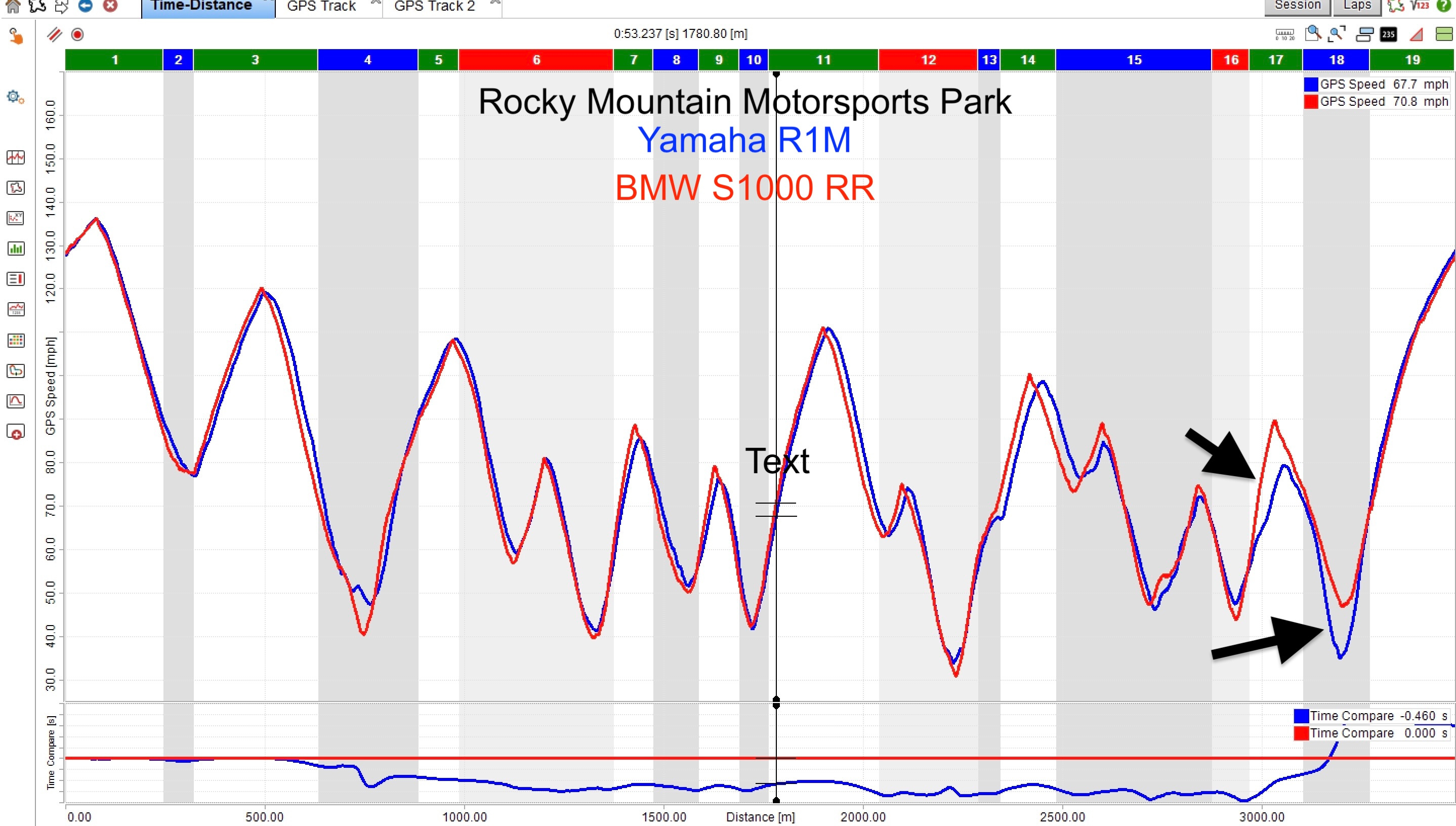
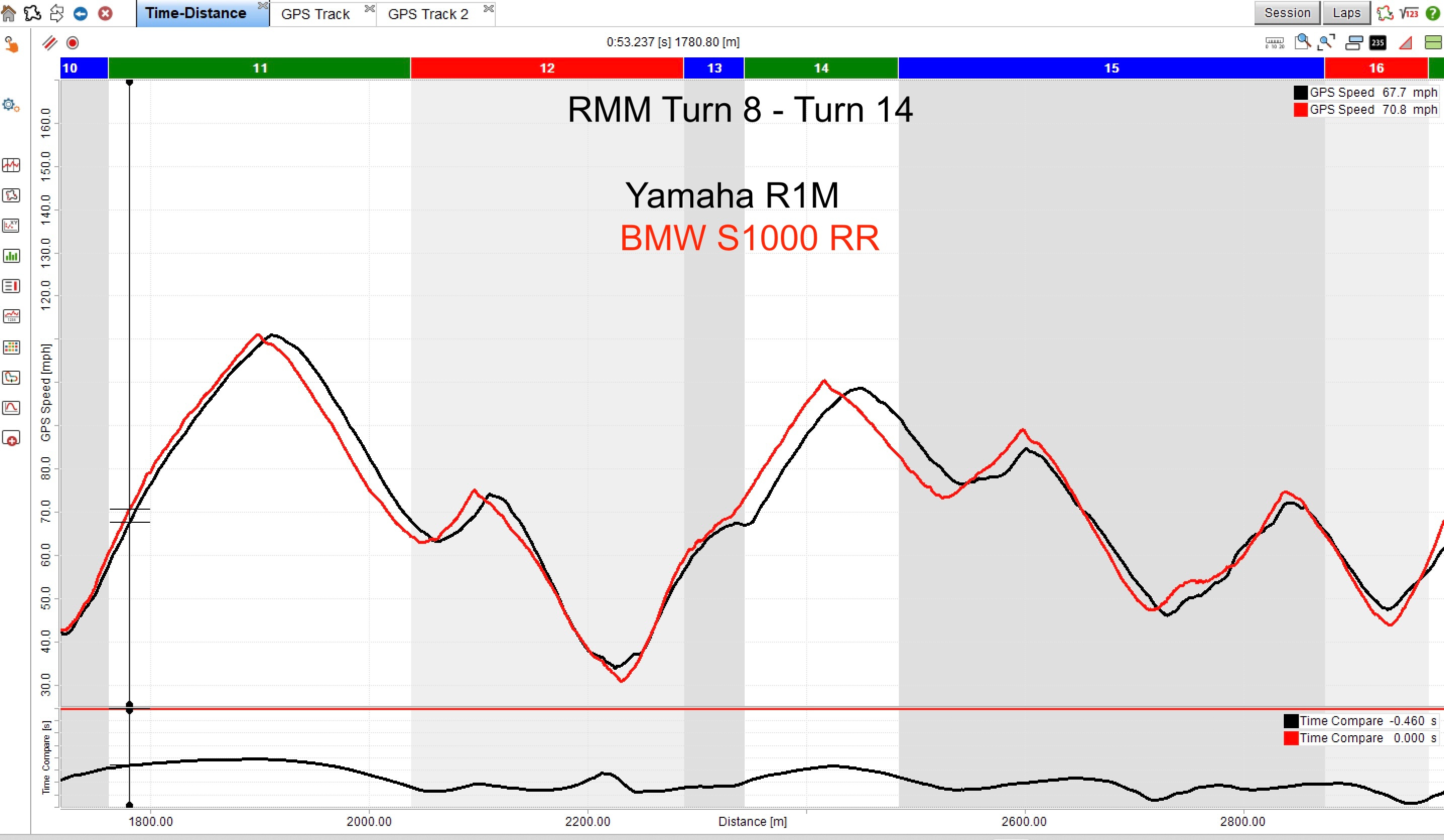
Wait… What? The R1M was quicker? Yep. That surprised me, too. Looking at the AIM GPS speed graph begins to explain what happened. Note: Due to traffic, the R1M has a lower speed through turns 15 and 16. That’s another reason I chose theoretical best times.
A few things stand out: The Yamaha pulled just as well in second gear as the BMW did in first. The R1M carried more entry speed, helped by not having to use first gear, but also because I needed to put more force into the fork and stiff-sidewall Bridgestone in order to get them to compress.
That braking later and harder also produced a slightly later slow point. The BMW felt more precise, more composed, I assumed I was lapping a lot faster, but I wasn’t. I was expecting a BMW landslide. Somehow, quietly, the R1M clawed itself to the top.
Winner: R1M. I didn’t see that coming.
Special notes
Here’s where it gets interesting. After I finished testing the YZF-R1M, I had the opportunity to ride a standard YZF-R1 for a few laps. (Thanks Rob!) The R1 felt like a completely different brand of motorcycle than the R1M.
For me, it’s better, with none of the electronic Öhlins issues. Proper shock support and a front end that actually compresses and gives me what I want. In fact, after riding quite a few new-generation Ducati V4s, the R1 felt like 80% of that experience.
That’s a compliment, a big one. The chassis worked, the suspension worked, and that intoxicating connection between your right hand and the rear tire was still there. The YZF-R1 is a bike I would like to get to know even better.
Which bike wins overall?
When I was testing for national motorcycle publications, the bike of choice ultimately came down to one simple question: Which one, right here and right now, would you line up to race? For me, the BMW wins.
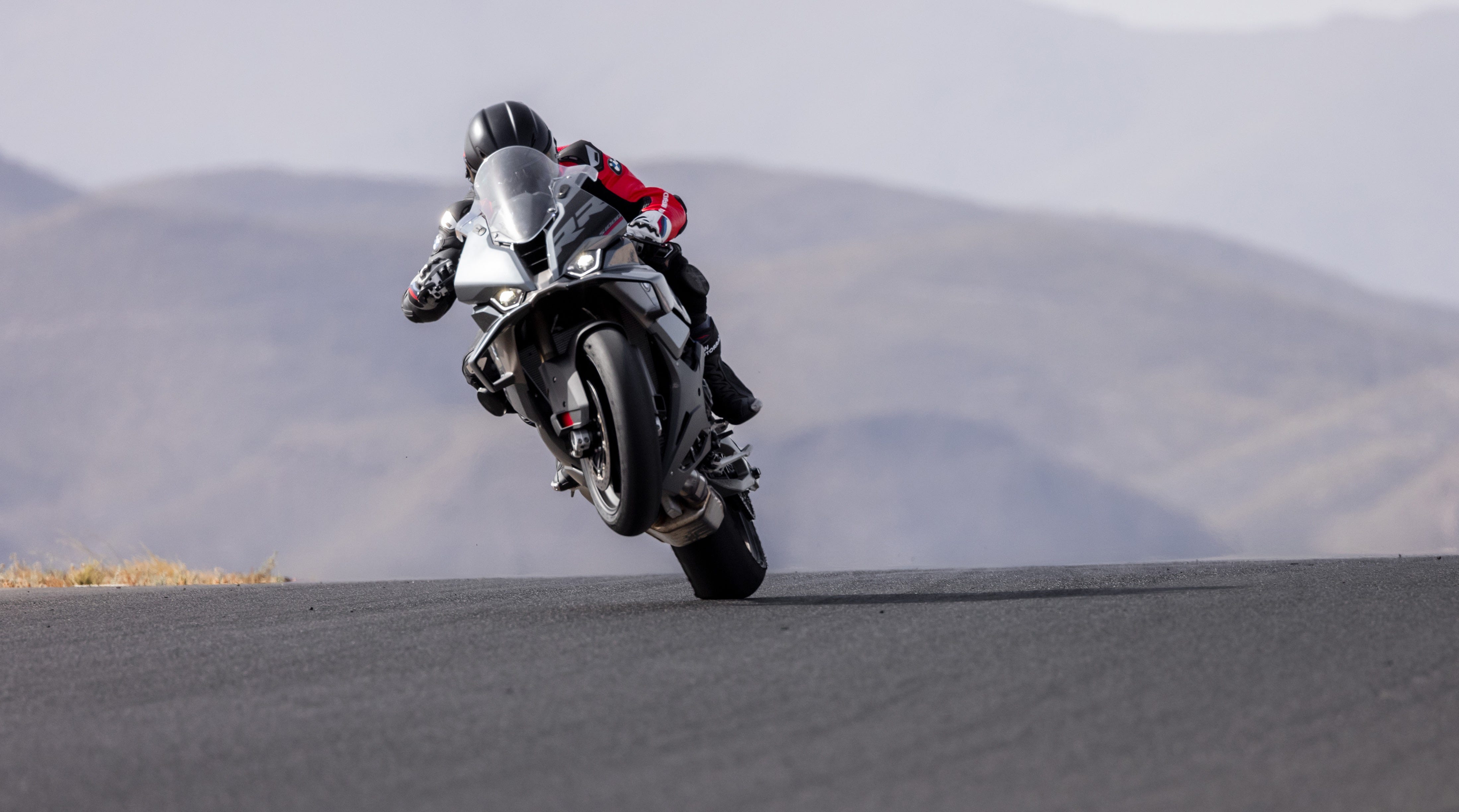
The S 1000 RR’s chassis, suspension, and braking feel outweigh the OEM flash and first-gear issues. Those are problems I know can be addressed. The fundamental platform underneath is incredibly good. I also feel the BMW is the best overall performance value.
For the price and with a few modifications, the S 1000 RR is capable of incredible lap times. That said, there is the standard YZF-R1. With its simpler analog suspension, intoxicating rear-tire feel, and crossplane engine, that particular Yamaha could be the dark horse.
I want to work with that motorcycle. Given the opportunity, then, I’d love to revisit this comparison, albeit on the same day and with the same tires: a YZF-R1 versus an unrestricted S 1000 RR. Hey, BMW and Yamaha, are you listening?
Special thanks
Being able to ride and compare these bikes wouldn’t have been possible without the support of exceptional people and organizations:
Rocky Mountain Motorsports Park Located north of Calgary, Alberta, RMM is a fantastic place to drive or ride. But it isn’t just the circuit that makes this venue special; it’s the people. They’re welcoming, passionate, and genuinely invested in motorsports and the people who participate in it.
Rob Darlington of HardNox Track Dayz Rob supplied both Yamahas, along with fresh Bridgestone tires, making this comparison possible. He runs a fantastic training program at RMM and is also one of my instructors for the RMM schools. Whether you’re brand-new to the track or a seasoned professional, Rob and HardNox have a program that can help you get more from your riding.
Justin Knapik of OnTrack Performance Justin, another one of my instructors, supplied the BMW S 1000 RR, fitted with fresh Pirelli tires from Perfect Lap. OnTrack Performance also runs an excellent program, based in Edmonton, with multiple training offerings to accommodate riders across a wide range of experience and skill levels.
Comparisons like this require far more than simply showing up and riding motorcycles. They require trust, time, equipment, tires, and people willing to support the process. I’m incredibly grateful to everyone who helped bring this unique experience together.
About Ken Hill
Ken Hill is considered the top motorcycle riding coach in the U.S. He bought his first motorcycle at age 30 and began road racing the very same year. Despite the late start, Ken went on to set track records and win class championships before making his professional debut in the AMA Superbike class, where he finished in the top 10 at age 41. Ken’s passion for learning and, ultimately, bettering the sport, led him to retire from racing in 2007 and devote himself full-time to coaching. Learn more at khcoaching.com.
Good stuff Ken, thanks for sharing!